BITNAUTIC TOKEN REVIEW


1. What is BitNautic?

SHIPPING, THE WAY IT SHOULD BE
BitNautic is a decentralized platform, based on the EthereumBlockchain, for matching demand and supply of shipping services, for all the industry stakeholders: producers of goods, ship owners, charterers, brokers, importers and exporters.
BitNautic comes with distinctive features like AI (Artificial Intelligence) based booking system, a real-time tracking of ships and cargo, and a wholesale e-commerce platform.

2. Challenges Facing the Shipping Industry
2.1 Challenges for Carriers
Security threats
The high number of incidents of piracy and armed robbery against ships off the Somalia coast and in the Gulf of Aden is something that the whole world is aware of, and is a growing concern for the maritime industry that is heavily affected by these incidents. Though the acts of piracy have been controlled to some extent, ship owners still use private armed security guards on their vessels while commuting the dangerous pirate zones in West Africa.

Not only armed robbery, the latest security threat to the maritime industry comes from hackers. Automated and technologically advanced ships have become vulnerable to cyber-attacks with hackers being successful in accessing the GPS, AIS – marine Automatic Identifcation System, and ECDIS – Electronic Chart Display and Information System (a system for viewing digital nautical charts)

Environmental Regulations
Maritime transport emits around 1000m tons of CO2 annually and is responsible for about 2.5% of global greenhouse gas emissions. These emissions are predicted to increase
up to 250% by 2050 in absence of installation of newer energy-saving technologies. There is a growing concern over the impact of global shipping activities on the environment
– greenhouse effect and danger to aquatic life.

The industry is working towards fnalizing the framework for the monitoring, reporting, and verifcation of CO2 emissions from maritime transport. However, in the absence of universally approved regulations and fully reliable technologies, there is uncertainty in the industry.

Overcapacity
The latest report from UNCTAD (The Review of Maritime Transport 2017) say that the seaborne trade grew by 2.6 per cent in 2016, reaching 10.3 billion tons. Although this was a welcome improvement to the 2.1 per cent growth recorded in 2015, the boost in demand was offset by a 3.2 per cent increase in the industry’s carrying capacity, which reached 1.86 billion dead-weight tons earlier this year.

A supply-demand imbalance continued therefore to weigh down industry profts, with the container shipping market, the largest in terms of value, reporting a collective operating loss of US$3.5 billion.

Lack of Transparency
Bad tracking is caused by equally harmful gaps in transparency. While tracking issues are systemic and inherent to the task of moving goods, the failures of transparency
are largely due to bad data handling practices (or worse, due to parties being incentivized not to share accurate data).

Often, due to fragmentation, uncertainty, or to protect the exclusivity of their arrangements, brokers can’t or won’t tell a shipper exactly what carrier and driver are carrying their
freight

Labor Disputes and Job Cuts
Who can forget the month-long West Coast dockworkers slowdown, which brought shipping industry business to a standstill in February 2015? Or, another incident in Dec 2015 when the Maritime Union of Australia (MUA) held the ship of global mining giant Alcoa, hostage for two months, disrupting the operations of the port of Portland?
Repeatedly, labor disputes and strikes have disrupted the shipping industry and created huge gaps in proftability and product rollouts. The shipping rates increase, and the supply chain becomes more overloaded.

2.2 Challenges for Shippers

Finding the best options
Cargo can be moved from point to point in a number of different ways. While it’s convenient to have options, many shippers are overwhelmed or simply unaware of the many different choices they have. Understanding the shipping landscape could save time and money at the end of the day

Finding the best rates
Looking for the best freight shipping rates can be time-consuming when not equipped with the right tools or processes. Most of the times, shippers have contracts in place (hindering flexibility) or have to make multiple phone calls just to fnd the
best rate for one shipment. Having a transportation management system in place could provide a solution to this problem

Preparation and documentation
Shippers sometime aren’t prepared to take on the process. From flling out the bill of lading to identifying freight classes, one misstep can result in surcharges, delays, or customs holds when shipping internationally.
Shippers must be sure to prepare ahead of time with the necessary knowledge to get the job done

Shipping demand exceeds forecast
Exporters and Importers often fnd themselves short on containers or bulk shipping capacity when they need them most. This leads to delays, additional costs, potential penalties and strained relations with clients as well as partners. In addition, shippers of time-defnite or sequenced cargo flows risk delays, performance penalties, and lost business when they can’t deliver on time, compelling some to resort to air freight or other alternatives in order to prevent penalties but the cost often outweighs the penalties.

In general, fnding the right balance between annual service contracts and the spot market is diffcult and comes with fnancial impacts.

3. INTRODUCING
BITNAUTIC


Global
Ship Owners, all over the world, can list their Ships and update the positions. Cargo Owners, in a similar way, can list their cargos, with detailed requirements. All users are able to
follow the actual conditions of the world freight market, with real-time positions at any port of the world.

Reliable
Shippers and Carriers beneft from a Reliable booking system based on effective digital contracts, backed by the Blockchain. Users execute a contract then, and there that locks in space, equipment and rate up to 6 months in advance. Carriers’ offers are all-in, and the rates are fxed.
Shippers never have any surprise accessorial and their rate never change. Invoices always match the contracts with 100% accuracy.

Secure
Contact information, ship name, and private data about assets are only available to the respective owners. BitNautic users decides when and with whom to share valuable information.

Easy to Use
Shippers just enter cargo origin and destination, ship dates and equipment type, then instantly receive binding offers directly from carriers along with service performance and
all the details they need to make an informed decision. Ship Owners just enter the Ship location and date, then instantly receive leads on matching cargos

Transparent
Public data representing the asset and contracts are stored in the
blockchain, accessible and auditable to all the parties, provided they have the required privileges. History of negotiations on each contract are always available on the Blockchain and easy exportable. This helps to avoid mistakes and guarantees the honesty between the parties.

Multi-Currency
To hold equipment and space on a vessel, Shippers submit a nominal deposit that gets credited toward their balance which is due before cargo is loaded. Any freight, chartering, sale and other services can be paid with cryptocurrency or BitNautic Tokens (BTNT).

4. BitNautic
Solutions

Shippers Challenges, Our Solutions


Carriers Challenges, Our Solutions


5. TOKEN DETAILS

Token Symbol:
BTNT
Token Type:
ERC20
Total Token Supply:
50,000,000 BTNT
Initial Distribution:
35,000,000 BTNT
Accepted Currency:
ETH
Exchange Rate:
1 ETH = 500 BTNT
Soft Cap:
5,000 ETH
Hard Cap:
50,000 ETH
Pre-ICO Starts:
May 1, 2018
Pre-ICO Ends:
May 31, 2018
Main ICO Starts:
June 1, 2018
Main ICO Ends:
July 30, 2018


USE OF FUNDS


MORE INFORMATION  :

SKYFсhain TOKEN REVIEW


INTRODUCTION


SKYFchain Operating Platform (hereinafter SKYFchain OP) is the first B2R (business-to-robots)blockchain based operating platform applicable globally in all sectors of a developing cargo robotics
industry. It will be initially developed and tested by using the first industrial cargo airborne robot –
SKYF drone – which will also give SKYFchain instant access to its client base for development of
unmanned business processes. Later all other unmanned cargo systems: in the air, on the ground
and at the sea will be connected to SKYFchain.


The first feedback from our customers in oil and gas industry confirms that if they switch from
helicopters to cargo drones they can supply their on-shore rigs with 5 to 10 times less cost.
SKYFchain as a blockchain with built-in smart contracts will provide trusted source of data and
reasonable control over unmanned assets for clients, logistics operators, insurance and leasing
companies, banks, and authorities worldwide.


It will unveil new profitable business opportunities for all industry participants, transportation system
with lower risk for the society, and increased overall affordability of goods and services due to
substantial cost cutting in the global supply chain.


During ICO we will issue 1 200 000 000 SKYFT tokens, which will be used in SKYFchain to facilitate all internal transactions.


We expect that value of SKYFT may increase over time because of two main drivers:


1. More and more companies, clients, financial institutions will be connected to SKYFchain which
will drive the growth of transactions in SKYFchain and demand on SKYFT.
2. For every SKYFchain transaction whether it’s getting loan to buy unmanned vehicle, client
payment or something else SKYFchain will charge some commission. 25% of commissions
will go to SKYFT holders.
1

1. SKYFchain OP business model

 
Logistics business processes today are designed with a human being in mind, either as a customer or
a controller etc. Autopilots for cargo robots, AI and the developing field of IOT hints that one day,
robots may work without being directly controlled by an individual


2. Project roadmap


2014 – 2017✓ securing $5 mln of VC funding;✓ design and manufacturing of SKYF cargo drones;✓ successful aerodynamic tests;✓ fully autonomous flights Q4 2017.

2018✓ SKYFchain project spin-off from the SKYF project;• research into the most suitable technology and development of a private block chainnetwork;• Development of logic and data of the SKYFchain OP in tight cooperation with all cargo
robotics market stakeholders (hardware producers, operators/clients, authorities,
banks/leasing companies);
• creation of the international legal structure;• sale of the first assembled SKYF drones and expansion of the partner network in the
regions without strict regulations on drone flights (
CIS, Asia, and Africa).

2019• dissemination of the private block chain network nodes among market participants;• launch of the with a franchise of a drone logistics operator and a license for third-party drone
producers.


2020• rapid growth in SKYF drone sales, as a consequence of expansion of the franchise of a drone
logistics operator and growth of number of licensed drone producers around the world;
• start of educational campaign and workshops for producers of other types of drones.

2021 - 2022• inclusion of third-party airborne drones into the SKYFchain;• lobbying for new regulations in developed markets through industry associations and roundtables.

2023 – 2025• inclusion of ground and sea-borne cargo robots into the system.


3. The Market

3.1 The market for air-borne cargo robots (drones)


$127bn – that’s how much PWC estimated the total addressable value of drone powered solutions to
be in all applicable industries. Exponential investments growth into the sector has already began.

$100bn – is the service market size for SKYF drone in agriculture, logistics, and infrastructure (see
Annex 4 for details). During the first three years it is expected that SKYFchain would service clients of  SKYF drones in these industries.


3.2 Unmanned trucks, ships and cars 


After the launch of air-borne drones, SKYFchain will invite other cargo robots, unmanned trucks,
unmanned ships, and later unmanned passenger vehicles.


We are planning to invite air-borne drones from 2020 onwards, and sea-borne and ground-borne
robots starting from 2022 onwards.

According to Abhimanyu Raheja, an analyst at BIS Research, "the overall number of automated
vehicles is expected to reach more than 110 million by the end of 2026.


Benefits of the unmanned trucks  


Proponents of automated trucks are talking about several useful features. They say that such trucks
will be more efficient because they would not waste fuel by accelerating and braking as frequently as
trucks driven manually by a human driver. Similarly, developers have plans to use truck platooning to
save on fuel. Other benefits may include: increased safety and less stress for drivers during long-haul
monotonous drives.


Passenger car drivers are ready to test automated cars
According to the press release of a Consumer Technology Association (CTA),™ most drivers (93
percent) use existing driver-assist features such as adaptive cruise control, parking assist, and
collision avoidance. They then appreciate the usefulness of these driving technology innovations.

3.3 Drone-related VC deals


According to the CBInsights report “The State of Drone Technology”1 VC funds have recognized an
opportunity in UC; the total disclosed VC capital raised for unmanned systems (drones) in the year
2016 increased by 123% to over $1,3bn


4. Problems in the drone market and unmanned logistics 


4.1 Lack of transparency 


Universal operating systems for the drone market still do not exist. There is no system where
customers can check the technical condition of drones and their safety itineraries. This is one of the
reasons why public authorities limit drone flight range.


This problem is not only present in the aviation industry. All the cargo robotics markets do not have
reliable certified operational platforms.
The organizational problems of the unmanned drone industry include costly insurance and nearprohibitive regulations in some countries.
  
   Solution is the SKYFchain OP

SKYFchain OP is a transparent and trusted operating platform that offers financing and gives
insurance companies direct control over their assets, which has sparked the growth of this industry.
 

4.2 Technical problems of air-borne unmanned logistics – short flight range ofexisting drones

Have you ever wondered why there are dozens of toy-drones in the market, yet the airports still have
large manned helicopters? Unfortunately, the multi-copter’s size scalability problem does not have a
solution yet at the moment. The higher the take-off mass, the larger the propeller has to be, which, in
turn, increases the momentum. This is how the aircraft rapidly reaches the controlable threshold.

Good rotor dynamics require an electric engine. However, the increase in scale of the drone comes
with a second problem
– accumulator batteries become ineffective. The internal combustion engine
can solve this issue. However, its implementation in drones remains problematic because of its high
weight. On the other hand, the hybrid engine’s cost is usually too high.

Solution – SKYF drone with a gasoline engine

The SKYF drone new aerodynamic design solves the problem of multi-copter scalability. The SKYF
drone is the world's first unmanned air cargo platform (unmanned aerial carrier, the drone) with
vertical take-off and landing (VTOL) based on patented aerodynamics, which allow for the
development of unmanned aerial vehicles with different modifications that can carry out a wide variety of challenging tasks.

The SKYF drone is easy to operate and less expensive when compared to other existing solutions,
and it allows for scaling in order to increase payload and flight range, as well as to configure other
characteristics


THE DRONE 


Model: SKYF P2-1

The SKYF Unmanned Aerial Carrier was designed and built at ARDN Technology Limited (UK),
whose R&D HQ is now located in Kazan, Russia. Areas of the system’s applications include: crop
spraying and long distance delivery of goods. The SKYF device is a vertical take-off and landing
device drone with two 2.8 m main rotors that synchronously rotate towards each other. The main
rotors, which generate lift to ensure the drone is air-borne, are driven by a gasoline engine. The
engine transmits torque through the gearbox and the belt drive to the main rotors.
SKYF drone technical characteristicsThe SKYF drone’s maximum useful load is 400 kg. The drone flight range can reach up to 350 km,
while the flight time is 8 hours (with 50 kg of cargo onboard).

SKYF drone mobilityThe SKYF drone transportation container can hold two vehicles. A container allows for customization for various purposes and SKYF drone modifications 


SKYF drone modifications

SKYF CARGO
The average payload is 150 kg with a maximum flight range of 350 km. This SKYF drone version is
the best solution for oil & gas logistics and for delivery in hard-to-reach areas. These services are in
great demand in Russia, Africa, Canada, Asia, Australia, South America, CIS countries and the
mountainous regions in Europe. SKYF drones can deliver goods (food, spare parts, measuring
equipment, emergency supply) from the logistics centers to designated residential areas.


SKYF MARINEThis modification has reinforced construction by adding corrosion protection. This SKYF drone can
work during emergencies in most regions of the world due to its increased reliability. It will be able to
deliver food, rescue equipment and medicine to natural disaster locations as well as evacuate the
injured and distressed at sea. Furthermore, this vehicle could serve in marine logistics centers and
intensive shipping regions to deliver medium-sized cargo (spare parts, mail, etc.) to ships at sea or on
the move, which will significantly reduce their service time and fuel consumption.


5. Pre-ICO and Terms crowdsale

Pre-ICO will be launched on 1st of March 2018Join the white-list to receive a 40% discount on your SKYFT tokens!The pre-ICO target is $1 000 000.
The pre-ICO hard cap is $2 000 000.

Only 51 300 000 SKYFT tokens is reserved for Pre-ICO.Minimum tokens purchase volume is 3000 SKYFT.
Collected funds will be stored on several accounts to limit potential impact of an attack by hackers.
We accept contributions in ETH and BTC. If you want to contribute BTC, you still need the ETH
address in order to receive tokens.
ICO is planned to be launched in May 2018
Exact ICO dates are to be announced.


ICO hard-cap is $30 000 000.
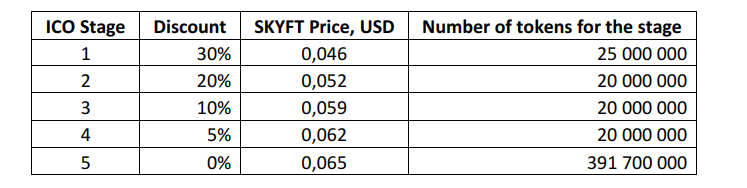
The final SKYFT token price at ICO will be $0,065.
528 000 000 of SKYFT will be available for purchase at ICO. Unsold tokens will be burned.
For each SKYFT token sold at the crowdsale 1,27 tokens will be created and will be split between
special token funds (see pie chart below).

Thus
the maximum number of tokens is 1 200 000 000 SKYFT.


MORE INFORMATION  :


Website: https://www.skyfchain.io/

Telegram:  https://t.me/SKYFchain and https://t.me/SKYFchain_chat

Twitter: https://twitter.com/SKYFchain

Whitepaper : https://fpivc.box.com/v/SKYFchainWhitePaper


Authorized By:

My Bitcointalk account : jagadlangit

My ETH address : 0xA2BFa48A6AfEFaBF498B6541f609E6cef4700D91

MoneyToken REVIEW


Introducing MoneyToken

MoneyToken - A Blockchain based Financial Ecosystem focused on cryptocurrency-backed lending and crypto assets leveraging

The main idea of MoneyToken that an innovative economic model allows you to hold onto your cryptocurrency and spend cash at
the same time.


MoneyToken consists of:

  • MoneyToken lending platform that provides loans in fiat currencies or stablecoin, secured by collateral in BTC and ETH;
  • MTC - MoneyToken’s own stablecoin;
  • MoneyToken decentralized Exchange service

What problem does MoneyToken solve?


MoneyToken has an innovative concept for some time; hold onto your cryptocurrency and spend it at the same time.

The problem has been obvious - spending crypto assets today prevents cryptocurrency holders from gaining on any future growth in asset value; investors who buy low need to hold on to their assets in order to benefit from selling high. It's a market where everyone is hodling.

But what if you need cash right now? Bills to pay? Equipment to buy?

This is where MoneyToken steps in.

The MoneyToken platform allows you to borrow liquid funds instantly, based on the current value of your cryptocurrency asset holdings.
 
 
  • You take out a loan, using your BTC/ETH as a collateral.
  • In return you receive an agreed loan amount in a stable currency.
  • And after repaying the loan you receive your whole collateral back; even if the collateral has increased in value multiple times

What makes MoneyToken unique from other lending platforms?

  • The platform is tailored to give out both small and large loans, from $500 to $1,000,000 and more.
  • No scoring or credit checks, since loans are backed by a collateral in 1:2 ratio.
  • In MoneyToken, credits are given out from one credit fund, which makes collecting a credit portfolio unnecessary, as opposed to
  • the regular p2p platforms.
  • Loan approval takes seconds and funds can be released almost instantaneously.
  • MoneyToken allows to apply for a credit not only in fiat currencies, but also in stablecoins, which is convenient in case the client
  • plans to use the credit funds inside the cryptocurrency market.
  • MoneyToken`s services will be available globally.
  • MoneyToken is an ecosystem, with it`s own stablecoin and decentralized exchange service.
  • MoneyToken does not use token mechanics to charge additional costs or hide services charges; instead our token plays a unique infrastructure role, providing benefits to customers such as a discount on platform services

Who might benefit from our services? 


  • Miners 
  • Exchange services 
  • Crypto holders, traders and investors 
  • ICOs

 How does it work?


How secure is the collateral? 


  • The deal`s conditions are captured in Ethereum-based contracts.
  • Collateral funds are kept in a wallet, protected by a multi-signature. To access the wallet, ¾ signatures are required. First one of them belongs to the borrower, second – to the lender, and the other 2 – to the platform.
  • Multichain-transactions and multichain smart-contracts will be available in the future, which would allow MoneyToken to becomecompletely decentralized

Token Functions

  • Privileged terms for platform users when depositing IMT to receive Borrower Membership.
  • Up to 60% discount on the platform fees for Borrower Membership. When using the discount from the user’s balance, the equivalent of 50% of the discount in USD is charged in IMT tokens.
  • The opportunity to become a creditor when depositing IMT for Lender Membership
  • Participation in decentralized voting.  

TOKEN INFO 


MORE INFORMATION  :


Website: https://moneytoken.com

Telegram:  https://t.me/moneytoken

Twitter: https://twitter.com/MoneyToken

Whitepaper : https://moneytoken.com/doc/MoneyTokenWP_ENG.pdf


Authorized By:

My Bitcointalk account : jagadlangit

My ETH address : 0xA2BFa48A6AfEFaBF498B6541f609E6cef4700D91

DOVU TOKEN REVIEW


DOVU’S VISION

G L O B A L V I S I O N
DOVU is shaping the crypto model for the mobility ecosystem. Introducing a transport
focused protocol to accelerate the development of mobility related decentralised applications
(dApps), the DOV token powers new business models in the transportation sector.

M O B I L I T Y I N E F F I C I E N C I E S & F I A T L I M I T A T I O N S
Fluid mobility is burdened by market inefciencies and fat limitations. Currently, there is
no reward mechanism for an individual to contribute value back into the ecosystem, such as
sharing data with service providers, or sending electricity back to the grid from their EV. In
essence, this means that an important well of value is left untapped, needlessly slowing down
the process of innovation. As it stands, we’re facing a world with self-driving cars, where
you still need to fll out paperwork for insurance, pay per fxed units of an hour, and you
don’t control your own driving data. Thankfully, blockchain is exceptionally well suited to solve
these problems
C I R C U L A R E C O N O M Y F O R M O B I L I T Y
Companies such as Uber or Airbnb are often cited as examples of the sharing economy,
but it could be argued that they are not exactly because they are centralised. A true sharing
economy is one in which individuals and companies are empowered by technology to share
their data and—if they wish—receive payment for it.

Because blockchain can verify value contributed independently, whether you are a corporate
or an individual, the DOVU Protocol empowers everybody to be fairly rewarded for their
contribution to the mobility ecosystem. This transforms 1:1 relationships to many:many.

Imagine your car paying you to drive it. Imagine being rewarded for all the data you create
and share. Imagine being able to use those rewards for travel, services, and transport globally.
Imagine this data being used to further improve mobility services, working towards fluid
movement of goods and people in our cities. Applying this technology will transform our
thinking about data and mobility. For example, when hailing an autonomous car, insurance
considerations are recorded in a Smart Contract, micropayments are usage-based, and the
DOVU ledger allows you to be rewarded for the data you share
D O V U E C O S Y S T E M
The DOVU platform consists of the following components, the DOVU Protocol (detailing
data interchange and attribution of value), the DOV token (for payment within the platform)
and the DOVU API Marketplace (the frst dApp developed by DOVU).
The DOVU Protocol sits at the core of our product and enables the creation of mobility
related dApps on our platform. Based on Ethereum, the DOV token is used for transactions
within these dApps. The focus and utility of these dApps will be fueled by the sharing and
consumption of data, therefore our own DOVU API Marketplace supports the community
further by simplifying access and development of mobility data globally. 

TOKEN DYNAMICS

D O V T O K E N
The DOV token is central to our ecosystem. It’s the unit of value that allows us to create this
new circular economy linking consumers to data providers (and vice versa) and also rewarding
those sharing data.

For our ecosystem to flourish in the transport sector we encourage use of the DOV token
within it, ultimately building more value for customers as adoption and utility grows.
The DOV token is the only unit of value used across DOVU platform. Every purchase, sale,
exchange or any other transaction on the platform will require the use of DOV tokens.

A decentralised global ledger combined with a token that’s required to use that ledger aligns
incentives and creates more intense product engagement. Blockchain uniquely rewards early adopters. The product becomes more useful as more users join and demand for the token
increases, which as a result increases the value of the ownership stake for users. In other
words, token utilisation and network effects continuously reinforce each other which benefts
early adopters.

Using the DOV token in your business has a number of advantages over creating your own
token. Building payment infrastructure is a non-trivial task. Adopting an existing payment
structure lowers development cost and increases time to market. Leveraging a stable currency
lowers barriers to adoption for end-users.

D O V U A P I M A R K E T P L A C E

The DOVU API Marketplace platform will provide data providers with the tools to list and sell
data to consumers, and also to defne costs and terms in Smart Contracts to be executed on
the blockchain. Developers can contribute to APIs, Smart Contract and app developments
and be rewarded in DOV tokens – this will organically grow the DOVU powered transport
API ecosystem.

Data Owner - An individual or organisation that ‘owns’ some data. Data is passed to data
providers and is signed so that any actor further up the chain can determine the authenticity
of the data.

Data Provider - An individual or organisation that takes ‘owned’ data and supplies it through
means of a documented API.
Data Consumer - An individual or organisation that interacts with the DOVU platform to
consume data from data providers, e.g. developers.

WHY NOW?
L A C K O F T R U S T
Most companies believe that information is a valuable commodity, and one worth hoarding:
the more we have of it, the more we can learn from it, and make changes that will drive
business success. This mentality demonstrates a lack of trust and limits progress for all
involved. When sharing data, it makes a difference if it is used for commercial or personal
ends, public or private ends, or if there is any exposure to misconduct. Lack of trust and fear
of competition are the main reasons why companies decide to remain non-transparent and
closed when it comes to data.

N O N - C O M P A T I B L E D A T A
Data doesn’t have inherent value. In essence, data is a combination of 1’s and 0’s. Value
is the desired outcome. The number one barrier to making data useful is inconsistency,
both through output and documentation. Imagine a world with connected cars and trains,
information-sharing infrastructure and trafc lights, and IoT enabled smart cities. This data
is built on different platforms, using varying protocols and following local regulations. Smart
cities and movement therein is a fast growing sector with increasing complexity. Data and
corresponding services are currently disparate, non-formalised and complex for developers
and businesses to share and consume.
N O N - U N I F O R M Q U A L I T Y
Deciding which API to use matters; an application is only as strong as its weakest API. Key
criteria for API evaluation are documentation, reliability, performance, and support. Firstly,
documentation serves for developers to understand the use case and API integration.
However, API documentation has many pressure points: organisation, design, versioning,
consistency, and much more. Writing good documentation is non-trivial task, and more
often than not poorly executed. Secondly, API performance is denoted by latency, uptime,
and robust SLA’s, not to mention undocumented facets like payload and quality. Across the
board, API performance varies widely. Lastly, depending on investment at publisher level,
developer support is generally limited - a real problem when troubleshooting or evaluating
whether an API is ft for your needs.

DOVU USE CASES

The DOV token can be used within the DOVU API Marketplace, or in mobility related
services outside the DOVU marketplace. The latter category covers a broad spectrum,
ranging from being used as a currency to enabling new decentralised business models.
The open source DOVU Protocol provides the necessary tools to build dApps using
the DOVU blockchain platform, unlocking benefts such as Smart Contracts, secure/
trusted transactions, conditional reward systems, micropayments, and novel alternatives to
standard authorisation in all kinds of mobility services.

TOKEN DISTRIBUTION EVENT

T O K E N D I S T R I B U T I O N O V E R V I E W

• 25% of the DOV Tokens (0.30B) will be made available to token sale participants (ITO).
• 35% of the DOV Tokens (0.42B) will be allocated to an user growth fund. Earned tokens,
by contributing the quality of the ecosystem, will originate from this fund. DOV Tokens
received as a reward can only be used within the DOVU ecosystem for value added
services. Any unused DOV Tokens after 6 months will be sent back to the user growth
fund which can then be used for new users.
• 15% of the DOV Tokens (0.18B) will be allocated to advisors, founders, and management
to help build the team. Team members vest for tokens in four installments of six months
each.
• 25% of the tokens (0.3B) will be held in reserve. The reserve is subject to a two-year
lock-down period.
0.5% of the token sale (1.5 million tokens) will be allocated to the Bounty program.
The bonus structure for the public token sale will be based on three tiers. Conditions for these
three tiers will be announced when the pre-sale closes on the 29th of September.
Tier 1: 10% discount
Tier 2: 3% discount
Tier 3: Announced token price


MORE INFORMATION  :


Website: https://dovu.io/

Telegram:  https://t.me/dovuofficial

Twitter: https://twitter.com/dovuofficial

Whitepaper : https://dovu.io/whitepaper.pdf


Authorized By:

My Bitcointalk account : jagadlangit

My ETH address : 0xA2BFa48A6AfEFaBF498B6541f609E6cef4700D91